Is Cast Iron Cookware Induction Safe? What to Know Before You Buy
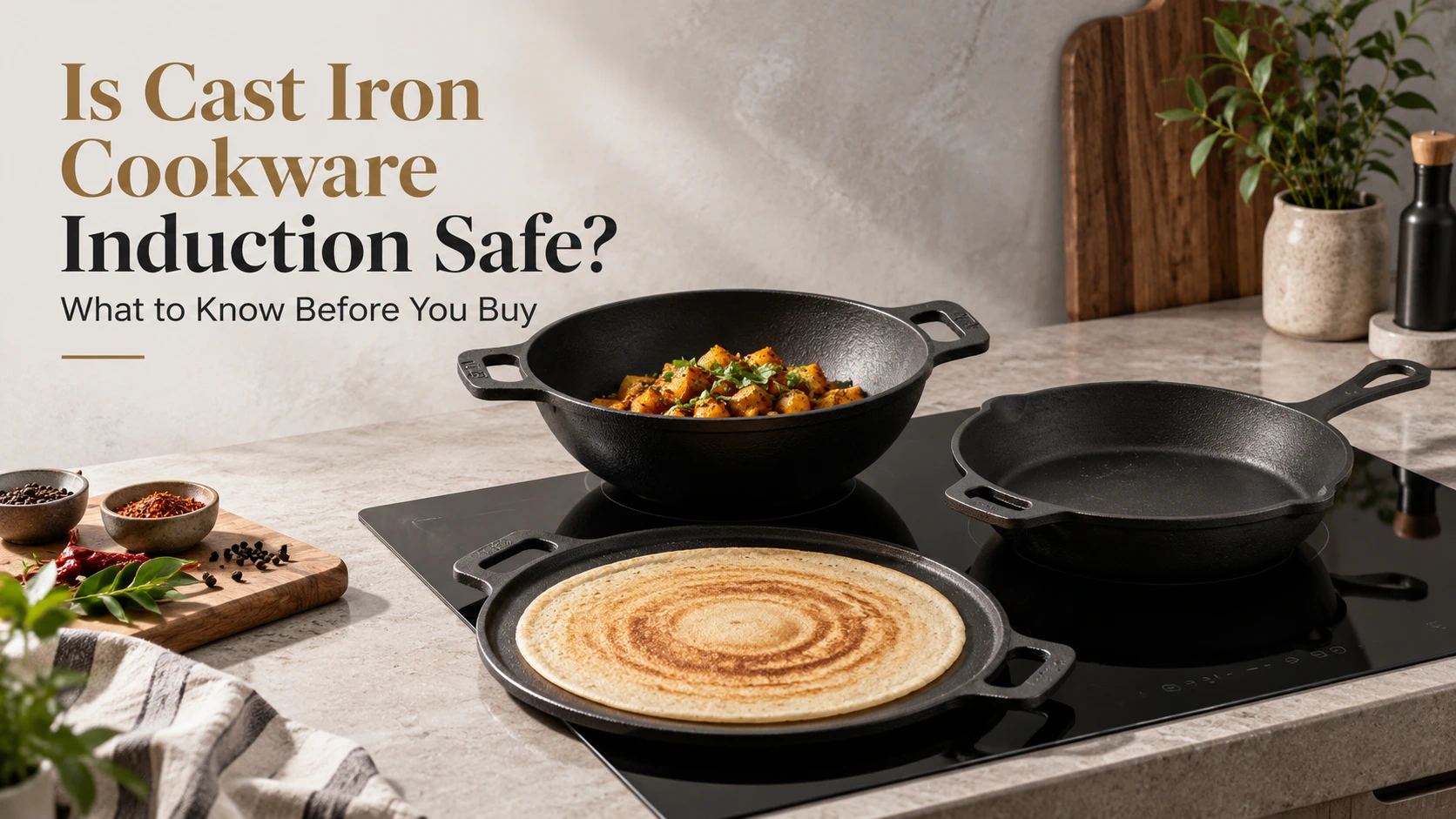
Switching to an induction cooktop does not mean giving up traditional iron cookware. Cast iron tawas, skillets and kadais can work well on induction, provided the base is compatible with your cooktop.
But a magnet sticking is not the whole story. Base contact, pan size and the way you heat cast iron all change how it cooks. Here is what to know before you use it.
In This Guide
- Why Does Cast Iron Work on Induction?
- How to Check Whether Your Cast Iron Pan Is Induction Compatible
- Can You Use an Iron Tawa on an Induction Cooktop?
- How to Protect Your Induction Cooktop from Cast Iron
- How to Cook Better with Cast Iron on Induction
- What Can You Cook on Cast Iron?
- Care After Every Use
- Common Mistakes to Avoid on Cast Iron
- What Is Normal on a New Cast Iron Pan?
- Cast Iron vs Coated Non-Stick
- Are Tri-Ply Stainless Steel Pans Also Suitable for Induction?
- Quick Answers
- Cast Iron on Induction: What to Remember
Why Does Cast Iron Work on Induction?
Induction heats cookware with an electromagnetic field, and iron responds to it, so cast iron generally works on induction cooktops.
Cast iron also holds heat well. Once it is warm, it keeps a steady temperature, which suits dosa, roti and everyday vegetables. The catch is that it takes time to warm through, even on an efficient cooktop, so heat it gradually before adding food.
How to Check Whether Your Cast Iron Pan Is Induction Compatible
- Do the magnet test. Hold a magnet to the base. If it sticks firmly, the base is likely suitable. This is a first check only, since the pan must also meet your cooktop maker’s requirements.
- Check the base. A flat, stable base keeps good contact with the glass. A warped or curved base can heat unevenly or may not be detected. Look at the underside, and read your cooktop manual if unsure.
- Match the pan to the cooking zone. A base that is too small may not be detected, and an oversized pan can heat unevenly. Check the recommended cookware size in your manual before choosing a tawa, skillet or kadai.
If you are unsure about a particular pan, ask us before you buy. Not every iron pan has a flat, induction-friendly base, so check each product rather than assuming.
Can You Use an Iron Tawa on an Induction Cooktop?
Yes, an iron tawa works on induction if its base is magnetic and compatible with your cooktop. For dosa and roti, the surface needs time to warm so food cooks evenly across the tawa.
- Start on a low or medium setting.
- Let the tawa warm gradually, then raise the heat only if needed.
- Keep the setting fairly steady while cooking.
- Do not add batter or dough to a tawa that has not preheated.
How to Protect Your Induction Cooktop from Cast Iron
Induction cooktops usually have a glass-ceramic surface, and cast iron is heavy with a naturally textured base. A little care protects both.
- Lift, do not slide. Dragging heavy cookware across the glass can scratch it.
- Place it down gently. Never drop a tawa, skillet or kadai onto the cooktop. A hard impact can damage the glass.
- Keep the surface clean. Wipe off food bits and grit from the cooktop and the pan base before cooking.
- Avoid sudden temperature changes. Follow your cooktop manual and let cast iron warm up and cool down gradually.
- Use the right cooking zone. Centre the pan, and avoid pans larger than your manual recommends.
How to Cook Better with Cast Iron on Induction
Technique changes slightly from a gas stove. These five steps give reliable results.
- Preheat gradually. Heat on low to medium for 2 to 3 minutes. Cast iron holds heat, so the highest setting is rarely needed.
- Apply oil. Add a small amount of oil and spread it evenly.
- Add food once the oil is hot. Do not overcrowd the pan.
- Cook undisturbed. Use low to medium heat and let the food cook without moving it.
- Let it release naturally. When cooked, the food releases on its own. If it clings, it usually needs another minute.
Tip: Once cast iron is hot it stays hot, even after you lower the setting. Reduce the power a little early instead of relying on continuous high heat.
What Can You Cook on Cast Iron?
One pan covers most everyday Indian cooking, because it holds steady heat.
| Dish type | Why cast iron suits it |
|---|---|
| Tadka | High heat releases the full aroma of whole spices. |
| Curries | Steady, even heat for slow cooking. |
| Sabzi | Quick tossing without sticking, once seasoned. |
| Deep frying | Holds oil temperature steadily. |
| Searing | A deep golden crust, such as on paneer or vegetables. |
| Roti and dosa | Even browning across the whole surface. |
Care After Every Use
- Wash gently. Use warm water and a soft sponge or brush.
- Dry completely. Dry at once, then warm on a low flame for 1 to 2 minutes.
- Add a light coat of oil. Apply a very thin layer inside and out while the pan is still warm.
- Store dry. Keep it in a dry place.
Need the full routine? Read our cast iron seasoning and care guide.
Common Mistakes to Avoid on Cast Iron
- Soaking it in water for long periods.
- Using harsh soaps or metal scrubbers.
- Putting it in the dishwasher.
- Leaving it wet after washing, which can lead to rust.
- Dragging it across a glass cooktop.
What Is Normal on a New Cast Iron Pan?
Cast iron is different from a coated pan by nature. These things are normal and do not affect cooking.
- A naturally rough texture. No synthetic coating is applied to make it smooth.
- Small marks and tiny pits. They are part of the casting process.
- Slight shade differences. Tonal variation does not affect performance.
- A surface that darkens with use. The seasoning builds and smooths as you cook.
Pre-seasoning is a natural layer of oil bonded to the iron. It is not a permanent synthetic non-stick coating, so it improves with every cook and needs a little care.
Cast Iron vs Coated Non-Stick
| Cast iron | Coated non-stick | |
|---|---|---|
| Heat | Holds heat well and suits high-heat cooking | Heats quickly; most makers advise low to medium heat |
| Surface | Seasoning built from oil, improves with use | Synthetic coating that can wear over time |
| Lifespan | Can last for generations with care | Depends on the coating and how it is used |
| Care | Dry and lightly oil after washing | Avoid metal tools and abrasive scrubbers |
Choose cast iron if you value durability, high-heat cooking and cookware that improves with time. If you expect a perfectly smooth, coated non-stick surface, cast iron may not be the right choice.
Are Tri-Ply Stainless Steel Pans Also Suitable for Induction?
Many tri-ply stainless steel pans are made for induction, but not every stainless steel pan is compatible. Induction needs a magnetic layer or base, and the construction of the layers decides whether a pan will work.
Before buying, look for a clear induction-compatibility statement in the product specifications. You can browse our tri-ply stainless steel cookware which works well on induction cooktop.
Shop Tri-ply Stainless Steel Cookware →Quick Answers
Can I use a cast iron tawa on an induction cooktop?
Yes, if its base is magnetic, flat and the right size for your cooking zone. Preheat it gradually.
Why is my induction cooktop not detecting my pan?
The base may be too small for the zone, warped, or not magnetic enough. Check the magnet test and your cooktop manual.
Will cast iron scratch my glass cooktop?
It can if you slide or drop it. Lift the pan, place it down gently and keep the base and cooktop clean.
Is pre-seasoned cast iron non-stick?
It is naturally slick once seasoned, but it is not a permanent coating. The surface improves with regular use and care.
Cast Iron on Induction: What to Remember
Cast iron suits induction cooking because iron is magnetic and holds heat. For the best results, choose a compatible pan, check the base and size, preheat gradually and handle the glass surface with care.
New to cast iron? Start with the seasoning and care guide, then explore our cast iron cookware for everyday cooking.
OREVIA. Designed to Belong.
Shop Cast Iron Cookware →
Keep reading
How to Clean and Care for Triply Stainless Steel Cookware
Easy ways to clean triply stainless steel cookware, remove burnt food and stains, and stop food from sticking.
Read the story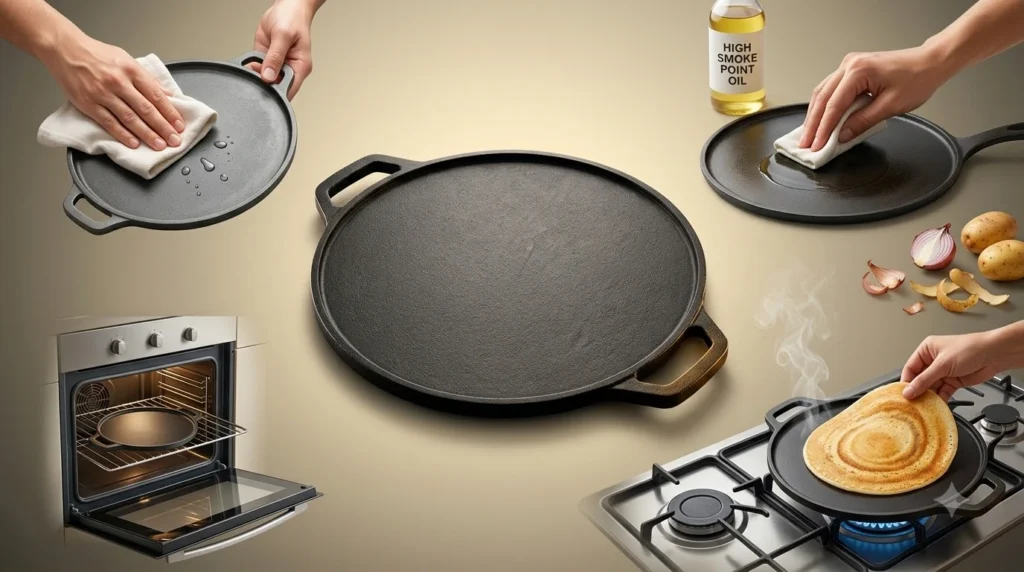
How to Season a Cast Iron Tawa at Home, Step by Step
A simple, step by step way to season an iron tawa at home on the stove or in the oven, with the common mistakes...
Read the story