What is actually in your pan?
What we read, what we learned and the numbers behind our story. Every claim on this page has its source linked at the bottom.
Read on ↓← Our storyThree things we read
We do not want to scare anyone. So we have stuck to what has been published, and every source is linked at the bottom of the page.
Particles from a single scratch
In a 2022 laboratory study, researchers at the University of Newcastle and Flinders University scratched Teflon-coated pans and counted up to about 9,100 plastic particles from one crack. A broken coating released millions of microscopic ones.1
Science of The Total Environment, 2022A heat limit for non-stick
India's own medical research body, ICMR, has cautioned against heating non-stick cookware beyond 170°C and against leaving it on the flame for long, and says worn pans should be replaced.2
ICMR–NIN dietary guidelines, 2024Why PFAS keep coming up
PFAS chemicals have been used to make non-stick coatings. In 2023 the International Agency for Research on Cancer classified one of them, PFOA, as carcinogenic to humans.3
IARC, via American Cancer SocietyNone of this proves that a particular pan harms a particular person, and the researchers themselves say more work is needed. We just wanted to make cookware where this question never comes up.
What actually touches your food
Our cooking is hard on a pan: tomato, lemon, tamarind, vinegar, high flames and a steel spoon scraping the base. This is how the common materials hold up in that kind of kitchen.
| Non-stick (PTFE) | Uncoated aluminium | IronOREVIA · cast & non-coated | Triply stainless steelOREVIA | |
|---|---|---|---|---|
| Synthetic coating (PTFE / PFAS) | YesThe cooking surface is a polymer coating3 | No | None | None |
| Plastic particles when scratched | YesAbout 9,100 particles from one crack in a lab test1 | No | NoThe seasoning is baked-on cooking oil, not plastic | No |
| If the pan is overheated | Coating can degradeICMR advises staying under 170°C2 | No coating to degrade | No coating to degrade | No coating to degrade |
| Aluminium that can touch food | Depends on the pan | YesThe whole pan is aluminium | None | NoneFood touches steel. The aluminium core is bonded between steel layers, and the rim is folded outward so its edge stays away from food |
| Acidic dishes (tomato, lemon, vinegar) | Coating itself is inertSee the rows above | More aluminium migratesIt rises with acidity and with cooking time4 | More iron comes outIron is a nutrient, in small amounts5. Long simmering of very sour dishes can wear the seasoning, so keep those short. Do not store acidic food like pickle or chutney in it2 | Largely unreactiveICMR notes stainless steel does not leach or react with acidic or alkaline foods2 |
This chart is about materials in general, not any one brand. The real numbers depend on the pan, the dish, the heat and how long you cook. In the aluminium study we cite, the highest levels came from pressure cookers cooking acidic food for a long time. All metal cookware can release trace amounts of metal into food, especially with acidic dishes. What differs is which metal, and how much. Each of our materials has its own care guide.
Iron has always been in Indian kitchens
Cooked in iron for generations
Your grandmother's kitchen probably had an iron tawa and a kadhai. Before steel and non-stick, Indian homes cooked in iron, clay, brass, copper and bronze, and families kept using them for reasons that were handed down. Some of that was habit and belief, and some was taste and durability.
Iron helps build your blood
Iron is the building block of haemoglobin, the protein in red blood cells that carries oxygen around the body.6 When iron runs low, haemoglobin falls, and that is what anaemia is. Women lose iron through the menstrual cycle, which is why they need more of it than men do.6
A little iron, in your daily food
Food cooked in an iron pan picks up a small amount of iron, and more so when the dish is moist or acidic, like dal with tomato or a squeeze of lemon. Reviews of trials in several countries found that it can raise the iron in food and, in some studies, haemoglobin too. The results were mixed and depended on who used the pots and how often.5
An iron pan adds a small amount to your diet. It is not a treatment for anaemia, and it does not replace medical advice or supplements prescribed by a doctor. If you have a condition that makes your body store too much iron, please ask your doctor first.
How much iron does the body need?
An adult body holds about 3 to 4 grams of iron in total, and most of it sits in haemoglobin.6 There is no single "minimum" number, so doctors look at three things: how much iron you eat, how much haemoglobin you have, and how much iron you have in store. These are the reference values.
| What is measured | Men | Women |
|---|---|---|
| Iron to eat every day ICMR–NIN recommended allowance for Indian adults7 | 19 mg | 29 mg |
| Lowest healthy haemoglobin Below this the WHO defines anaemia8 | 13 g/dL | 12 g/dL non-pregnant |
| Iron in store, as serum ferritin Below this the WHO defines iron deficiency9 | 15 µg/L | 15 µg/L |
| People with anaemia in India, ages 15 to 49 National Family Health Survey 5, 2019–2110 | 25.0% | 57.0% |
These are general reference values. Your own needs depend on your age, health and diet, and a blood test with your doctor is the only way to know your iron status.
Cast iron
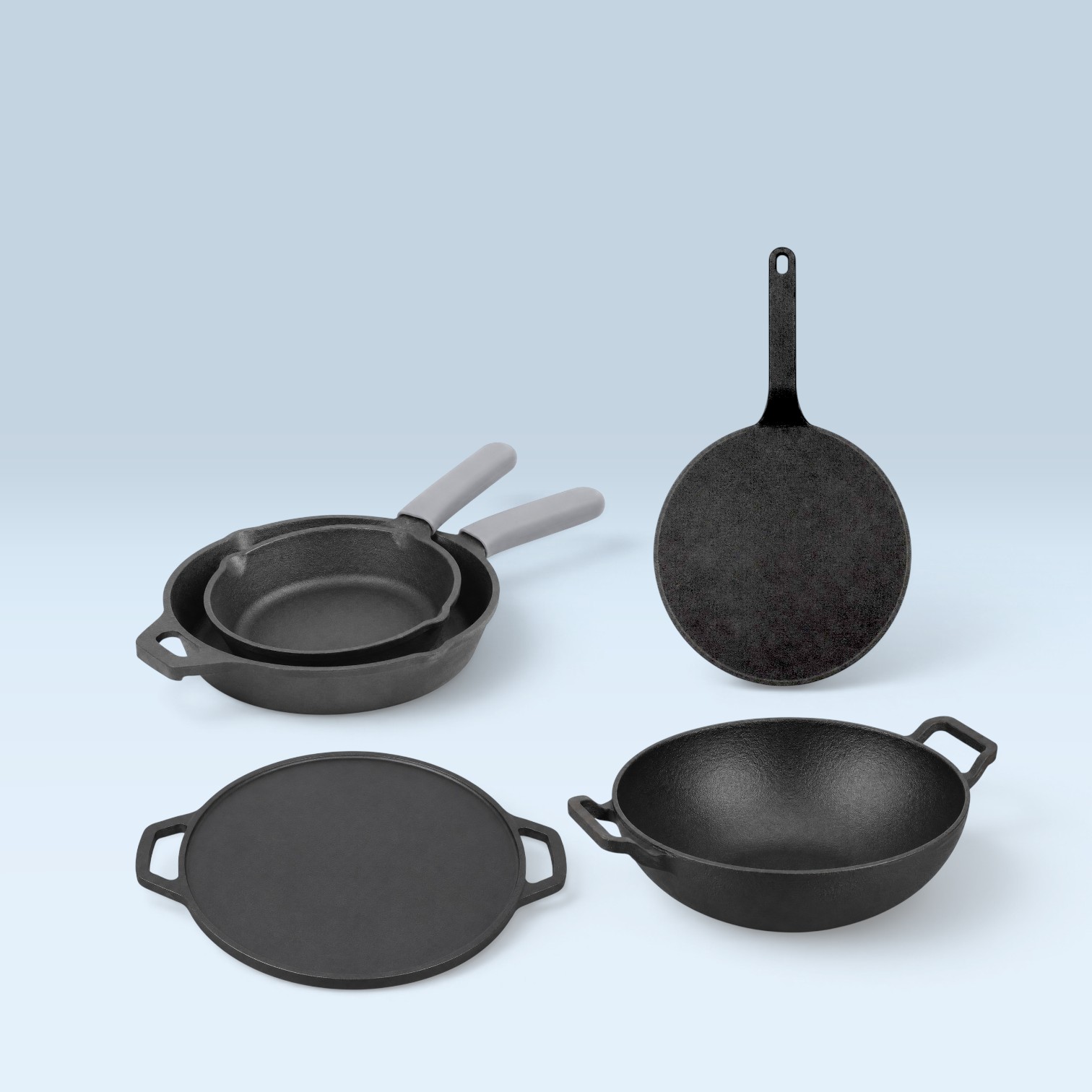
Pre-seasoned · No synthetic coatingCast as a single solid piece. Heavy, naturally textured and good at holding heat, which is why we use it for tawas, kadhais and skillets.
See cast ironNon-coated iron
Sheet iron · Smooth surface · No synthetic coatingMade from sheet iron with a smooth surface. Like cast iron, it is bare iron that you season with oil, with no coating on it, but it is lighter and does not have cast iron's textured surface. A little oil is enough to make it non-stick, so you cook with less oil. It has a flat base and works on induction as well as gas.
See non-coated ironGood food needs even heat
Health is the first reason OREVIA exists. The second is simpler: food should come out the way you meant it to. In an Indian kitchen that means a patient bhunai, a gravy that simmers slowly, a dal that cooks for an hour, and a sabzi that must not catch at the bottom.
Plain stainless steel pots are usually made from one thin sheet, between 22 gauge (about 0.8 mm) and 16 gauge (about 1.6 mm). Steel does not carry heat well, so a thin steel pan gets very hot where the flame touches it and stays cooler elsewhere. These hot spots mean one part of the dish overcooks while another is still raw, and the base burns and sticks. Thin sheets can also warp over time.
Thickness alone does not fix this. What fixes it is putting a better heat carrier inside the steel, which is how our triply is built.
One thin sheet, 22 to 16 gauge.
Three bonded layers, with aluminium in the middle.
Inside our triply
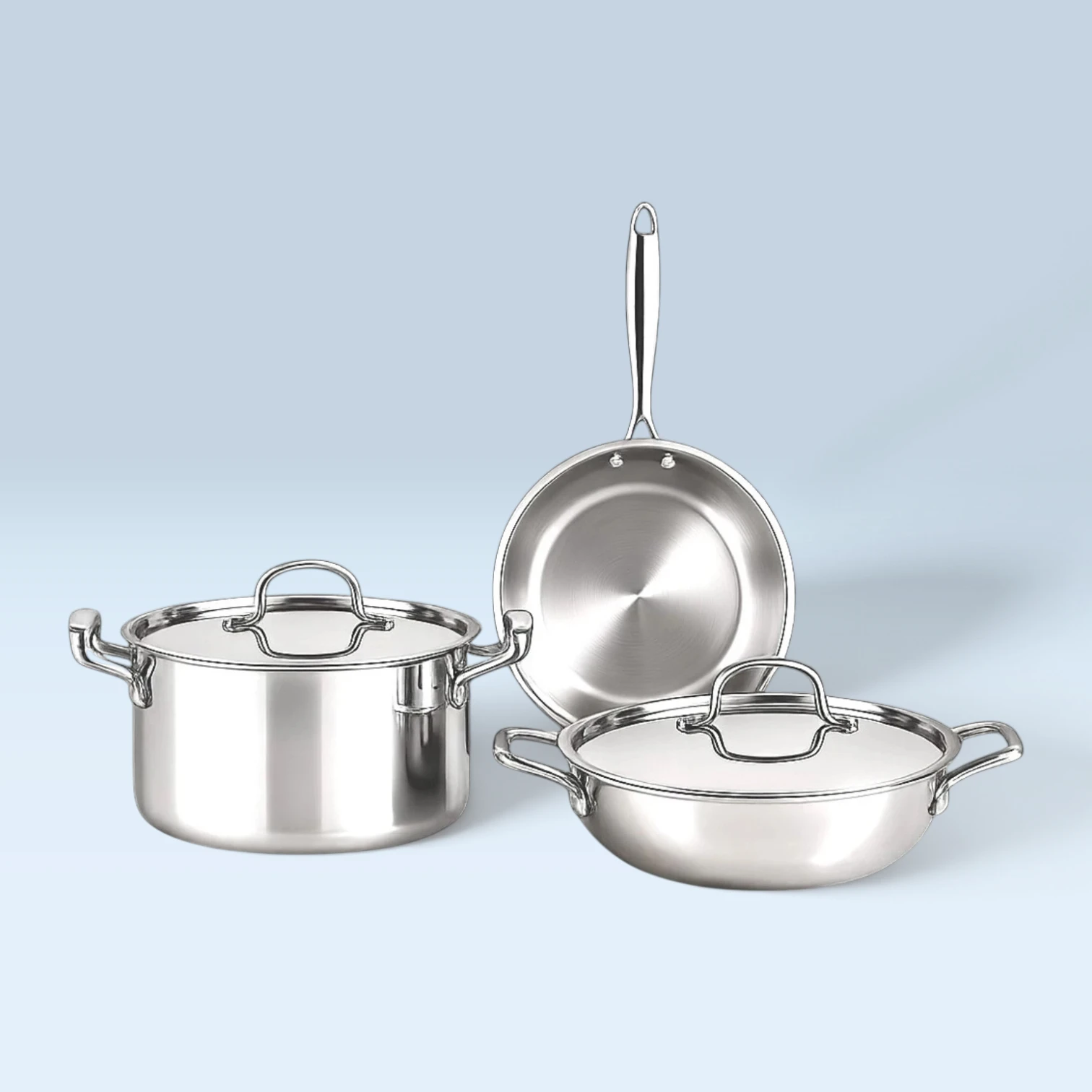
2.5 mm · three bonded layersThe rim. We fold the rim outward, with a border of about 5 mm, so the edge of the aluminium core sits outside the pan and stays away from your food.
Induction ready
The 430 magnetic outer layer lets the pan work on induction as well as gas.
Flat base, induction ready
Our cast iron pieces have a flat base, so they work on induction. Roti tawas are the exception.
Induction and gas safe
Made from sheet iron with a flat base, so it works on induction as well as gas.
Thick metal cooks slowly, on purpose
The thickness of a pan decides how it handles heat, and how it handles heat decides how your food turns out. This is why OREVIA cookware is made from thick metal.
Reacts instantly
A thin pan heats up fast and cools down just as fast. It has very little heat stored in it, so whatever the flame does goes straight into the food. Leave it a moment too long and the base burns. Add cold ingredients and the temperature drops.
Holds the heat
A thick pan stores heat and gives it back evenly and steadily. Once it is hot it stays hot, so you can cook on a lower flame and the food cooks gently from all sides. In iron, it is the mass of the metal that does this. In triply, the aluminium core helps as well.
Tadka
Spices give their flavour and aroma to hot oil gradually. Steady heat gives a tadka time to release its flavour. A very hot pan burns the same spices and turns them bitter.
Steady heat, less to lose
India's dietary guidelines note that cooking at high temperatures can destroy nutrients and form harmful substances, and that the longer a vegetable is stir-fried, the more vitamin C it loses.2 Other research points the same way: the biggest losses come from long cooking at high temperatures.11 Food that browns too dark can also form unwanted compounds such as acrylamide, and the advice from European food-safety experts is simply: don't burn it, lightly brown it.12 A pan that holds an even heat makes that easier to do. Slow does not mean long. It means steady, moderate heat.
Pick the pan you use most
Questions before you buy? Write to care@oreviahome.in or message us on WhatsApp.
Sources
- Fang C. et al., “Raman imaging for the identification of Teflon microplastics and nanoplastics released from non-stick cookware”, Science of The Total Environment, 2022. Summary: Flinders University news, 31 Oct 2022.
- ICMR–NIN, Dietary Guidelines for Indians, 2024. Guideline 13 (cooking methods) and “How to safely use cookware?”: non-stick pans not above 170°C, stainless steel does not react with acidic or alkaline food, acidic food not to be stored in aluminium or iron vessels, and high-temperature cooking can destroy nutrients. Also reported in The Week, 1 June 2024.
- American Cancer Society, PFOA, PFOS, and Related PFAS Chemicals, citing the IARC classification of PFOA as carcinogenic to humans (Group 1) and PFOS as possibly carcinogenic (Group 2B).
- “Investigation of Element Migration from Aluminum Cooking Pots Using ICP-MS”, Applied Sciences, 2023. Read the paper.
- Geerligs P. et al., “Food prepared in iron cooking pots as an intervention for reducing iron deficiency anaemia in developing countries: a systematic review”, 2003 (link); and “Effect of cooking food in iron-containing cookware on increase in blood hemoglobin level and iron content of the food: a systematic review” (link).
- National Institutes of Health, Office of Dietary Supplements, Iron: Fact Sheet for Health Professionals.
- ICMR–NIN, Nutrient Requirements for Indians, 2020: recommended dietary allowance for iron, adult men 19 mg/day and adult women 29 mg/day. Brief note.
- World Health Organization, Guideline on haemoglobin cutoffs to define anaemia in individuals and populations, 2024. Adult men 13 g/dL, non-pregnant women 12 g/dL.
- World Health Organization, Guideline on use of ferritin concentrations to assess iron status in individuals and populations, 2020. Serum ferritin below 15 µg/L in healthy individuals aged 5 years and above.
- Ministry of Health and Family Welfare, National Family Health Survey 5 (2019–21), as reported by the Press Information Bureau: anaemia in 25.0% of men and 57.0% of women aged 15 to 49.
- Healthline, How Cooking Affects the Nutrient Content of Foods: shorter cooking at lower temperatures with little water preserves nutrients best, and the largest losses come from long cooking at high temperatures.
- European Food Safety Authority, Acrylamide in food: forms in starchy foods baked, fried or roasted at high temperatures (120 to 150°C); advice is to avoid burning and brown lightly.
- RMFG, Stainless Steel Gauge Thickness: 16 gauge is 1.587 mm and 22 gauge is 0.794 mm.